

Hey there! As a supplier of Acrylic Acid 79 - 10 - 7, I often get asked about its solubility in water. solubility is a key factor when it comes to using Acrylic Acid in various applications, so let's dive right in and explore this topic.

First off, what exactly is Acrylic Acid 79 - 10 - 7? Well, it's a colorless liquid with a sharp, pungent odor. The CAS number 79 - 10 - 7 is like its unique ID in the chemical world. It's widely used in the production of polymers, adhesives, coatings, and a whole bunch of other stuff. And that's where the solubility in water becomes super important.
So, how soluble is Acrylic Acid 79 - 10 - 7 in water? Acrylic Acid is miscible with water in all proportions. That means you can mix it with water in any ratio, and it'll form a homogeneous solution. This is pretty cool because it gives us a lot of flexibility in using it. Whether you need a highly concentrated solution or a very dilute one, you can easily achieve it by adding the right amount of water.
The reason behind this high solubility lies in the chemical structure of Acrylic Acid. It has a carboxyl group (-COOH) at one end. This group is highly polar, which means it has a positive and a negative end. Water, on the other hand, is also a polar molecule. Polar molecules tend to dissolve well in other polar substances because the positive and negative ends of the molecules can interact with each other through a process called hydrogen bonding. In the case of Acrylic Acid and water, the hydrogen atoms in the water molecules can form hydrogen bonds with the oxygen atoms in the carboxyl group of Acrylic Acid, and vice versa. This strong interaction between the molecules allows Acrylic Acid to dissolve so readily in water.
Now, let's talk about why this solubility matters in real - world applications. In the polymer industry, for example, Acrylic Acid is often used as a monomer to make various types of polymers. By dissolving it in water, we can create an aqueous solution that can be easily polymerized. This is more environmentally friendly compared to using organic solvents, which can be harmful and expensive to dispose of.
Another application is in the production of adhesives. Water - based adhesives are becoming more and more popular because they're less flammable and have lower volatile organic compound (VOC) emissions. Acrylic Acid's solubility in water makes it a great ingredient for these types of adhesives. It can be incorporated into the adhesive formulation in an aqueous solution, and then cross - linked to form a strong bond.
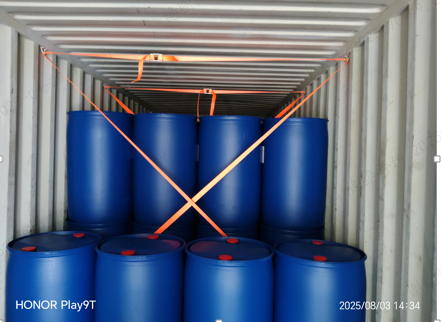
If you're interested in our Acrylic Acid products, we have some great options. Check out Acrylic Acid For 20GP. This product is suitable for large - scale transportation and storage in 20 - foot containers. We also offer Acrylic Acid For 20GP With Drums And Pallets, which provides a more organized and convenient way to handle the product. And if you're looking for high - purity Acrylic Acid, our Glacial Acrylic Acid 79 - 10 - 7 is the way to go.
When handling Acrylic Acid, it's important to take some precautions. Even though it's soluble in water, it's still a corrosive substance. It can cause severe skin burns and eye damage. So, always wear appropriate protective equipment like gloves, goggles, and a lab coat when working with it. Also, make sure to store it in a cool, dry place away from heat sources and incompatible materials.
In conclusion, the solubility of Acrylic Acid 79 - 10 - 7 in water is a really important property that opens up a wide range of applications. Its miscibility with water gives us the flexibility to use it in various industries, from polymers to adhesives. If you're in the market for high - quality Acrylic Acid, we're here to supply you with the best products. Don't hesitate to reach out if you have any questions or if you're interested in starting a purchase negotiation.
References:
- "The Chemistry of Acrylic Acid and Its Derivatives", Chemical Industry Press
- "Handbook of Polymer Science and Technology", Wiley - Interscience